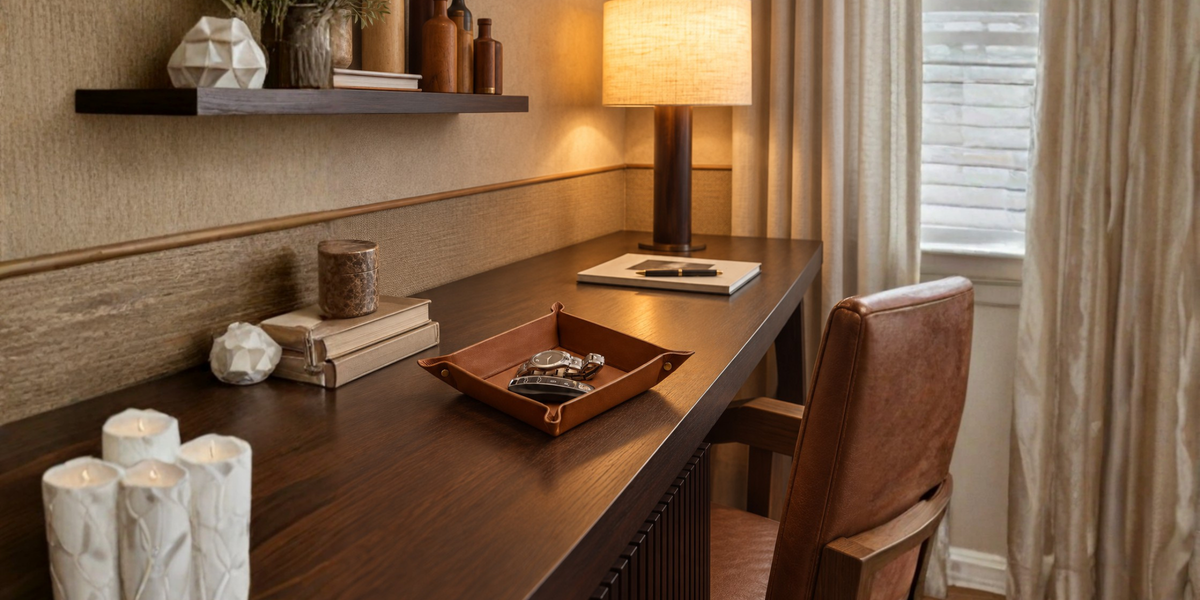
A guest checking into a boutique hotel in Lisbon, Copenhagen, or Hoi An rarely remembers the lobby chandelier a week later. What stays with them is the weight of the room key in the hand, the smell of the linen, and the small wooden or leather tray sitting beside the kettle, holding two ceramic cups and a folded card with the morning coffee instructions. In-room amenity design is the part of hospitality that lives at arm's length from the guest, and it carries a disproportionate share of the room's emotional weight.
This article looks at how interior designers and FF&E specifiers approach in-room amenity trays for boutique and independent hotels, why small accessories have become a competitive front, and how a category like woven leather tea and coffee boxes fits into the broader conversation about hospitality tabletop accessories.
Why Does In-Room Amenity Tray Matter In Hospitality Design?

An in-room amenity tray is the organised surface inside a hotel guest room that holds tea, coffee, water, and related accessories for guest self-service, usually placed near the minibar, on a console, or on the writing desk. It is one of the most touched objects in the room and one of the most visible in guest photography.
In FF&E hierarchy, the amenity tray sits below the case goods and lighting, but above the disposables. It is specified once and lived with for years, which puts it closer in lifecycle to a side table than to a bottle of shampoo. Designers treat it as part of the room's tabletop language, alongside the writing tray, the laundry bag holder, and the in-room collateral folder.
The category matters more than its budget line suggests. Guest reviews on Booking.com and Tripadvisor consistently surface small in-room details in both positive and negative comments, and hospitality observers have noted that experience-driven boutique properties tend to see stronger repeat-booking patterns than chain equivalents in the same price band. The amenity tray is a quiet contributor to that pattern.
How Small Details Shape The Luxury Hotel Experience

Luxury in hospitality has shifted away from scale and toward the sense that everything within reach of the guest has been chosen on purpose, and that nothing in the room feels like a placeholder.
A guest who notices that the tea box matches the warmth of the timber headboard, that the stationery folder is the same leather as the key holder, and that the tissue cover is not a plastic afterthought, registers all of this as one signal. The signal is that the operator has paid attention. The opposite signal, a generic acrylic tray with a paper liner from a hotel supply catalogue, registers just as clearly.
Three categories of small detail tend to do the heaviest lifting in this perception. The amenity tray sets the tone of the morning routine. The stationery and welcome card set the tone of arrival. The key holder, valet tray, and tissue cover set the tone of the in-between moments when the guest is moving around the room. None of these items is expensive on a per-unit basis, and yet they are the items guests photograph and the items they remember.
What Hospitality Designers Consider When Specifying In-room Amenities

Designers specifying in-room amenities work through a recurring set of questions before approving a piece for a project. The questions are practical, not aesthetic alone.
- Scale and proportion relative to the minibar or coffee station. A tray that overshoots the surface by even two centimetres reads as wrong. Designers usually map the amenity tray to the depth of the console it sits on, not to a standard size.
- Material compatibility with the room's interior palette. Leather, timber, ceramic, and woven materials each carry temperature. A cool grey stone bathroom calls for different amenities than a warm rattan-and-teak guest room.
- Durability and cleanability under hotel use. Housekeeping cleans the amenity surface daily. Anything that stains, absorbs odours, or shows water rings within six months is rejected at sampling stage.
- Branding and customisation options. Some operators want a discreet embossed initial. Others want no branding at all. The supplier needs to support both ends without making the item look like merchandise.
- Sourcing lead time and replacement availability. A piece that takes nine months to reorder and arrives without colour consistency creates an operational problem two years into the property's life.
These five filters narrow the shortlist faster than any visual moodboard, and they are the reason many beautiful catalogue items never make it into a real hotel room.
Material Choices For Hospitality Amenity Trays

Designers working on hospitality tabletop accessories generally choose between four material families, each with a defined behaviour in guest-room conditions.
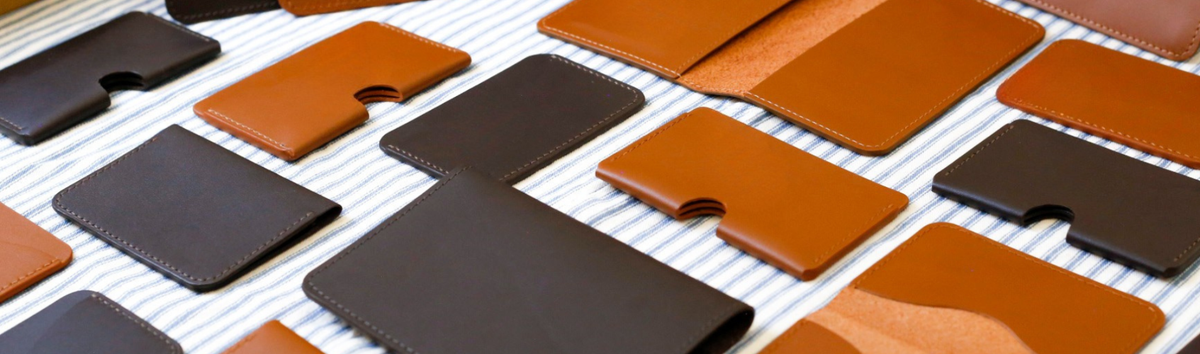
Leather brings warmth, ages visibly in a way that reads as character rather than damage, and pairs naturally with both timber and stone interiors. It needs to be specified in a tannage that resists humidity, which matters for tropical and coastal properties. Woven leather adds tactile interest without the maintenance burden of fully smooth surfaces, where every fingerprint shows.
Wood sits well in Japandi, Scandinavian, and tropical resort palettes, but it requires sealing and can crack in dry air-conditioned rooms over time. Ceramic photographs beautifully and cleans well, but breakage in housekeeping rotation is the silent cost. Melamine and engineered composites dominate the chain-hotel and budget segments because of price and replaceability, but they read as plastic in any room aiming above a four-star perception.
Leather has been gaining ground in the boutique and upper-midscale segment for a specific reason. It carries the visual weight of a considered object without the fragility of ceramic or the maintenance cost of solid timber. For boutique hotels that want their amenity layer to feel like part of the room rather than a hotel-supplied insert, leather is the most workable middle ground.
The Woven Leather Tea and Coffee Box from Neyuh Home & Travel

A woven leather tea and coffee box is a hospitality amenity piece that holds tea, coffee, and accompanying items in a covered structure with a textured leather lid. Neyuh Home & Travel produces a version of this piece specifically for boutique hotels and design-led hospitality projects, with internal compartments for tea bags, coffee sachets, sugar and creamer packets, and a stirring spoon. The proportions are calibrated to sit on a standard minibar console or a writing desk without crowding the surface.
The woven leather lid is the defining element and gives the piece a textural quality that reads differently under directional room lighting than a flat panel would. The body is finished in vegetable-tanned leather available in several tones, which allows the box to work across tropical resort interiors, contemporary European hotel palettes, and the quieter modern luxury rooms favoured by independent operators in cities like Singapore, Bangkok, and Lisbon.
Neyuh Home & Travel is one of five brands operating under Gallery de Neyuh, a leather workshop based in Saigon with 17 years of production history. The workshop's hospitality and lifestyle line has been distributed internationally through Wolf & Badger in London, and the team works directly with hospitality designers on project specifications rather than through generic catalogue distribution.
Customisation and Procurement Notes For Hospitality Projects

Customisation options for hospitality leather amenities typically include colour matching, embossing, and dimensional adjustment, with workshops working directly to designer specifications. Neyuh Home & Travel follows this model. Available adjustments include leather colour matching to a project's interior palette, discreet embossing or monogramming on the lid or interior, and dimensional adjustment when the standard size does not match the specified console depth.
Minimum order quantities for made-to-order leather amenities in this category usually start in the range of 30 to 50 units per design, which corresponds to a small boutique property or a single floor of a larger hotel. Sample lead time for a customised piece sits around three to four weeks from approved tech pack, and production lead time for a full project order runs eight to twelve weeks depending on the customisation scope.
The typical project flow begins with a designer or procurement manager sharing the room concept, interior palette, and quantity. The workshop responds with material swatches, a sample unit, and a production timeline. Final orders are scheduled to align with the property's FF&E installation window, which usually means coordinating with the project's general FF&E supplier rather than shipping in isolation.
Why In-Room Amenity Design Is Becoming A Competitive Advantage For Boutique Hotels?

In-room amenity design has become a competitive advantage for boutique hotels because it lets independent operators differentiate the guest experience at a fraction of the cost of a full room renovation. Boutique and independent hotels are competing against international chains on a field where the chains have larger budgets for renovation, marketing, and loyalty programmes. The lever that independent operators control more easily is the texture of the in-room experience, and amenity design is one of the highest-impact entries on that list.
A full room renovation costs tens of thousands of dollars per key. A complete refresh of in-room amenities, including trays, stationery, key holders, and tissue covers, costs a fraction of that and changes the guest's perception of the room almost immediately. For an independent property trying to move its average daily rate up by fifteen or twenty percent over two years, the amenity layer is one of the few places where the spend-to-impact ratio is genuinely favourable.
The shift is visible in how design publications are covering hospitality. Design publications covering hospitality, including Cereal, Wallpaper, and Monocle, have increasingly treated in-room object design as part of a property's identity rather than a back-of-house procurement decision. The amenity tray, once an afterthought, is now part of how a hotel tells its story.
Frequently Asked Questions
What is the difference between standard hotel amenity trays and custom-designed ones?
Standard hotel amenity trays are sourced from hospitality supply catalogues in generic shapes and materials, usually melamine or stainless steel, with no relationship to the specific room's interior. Custom-designed amenity trays are specified to match the room's palette, scale, and material language, and they carry the operator's identity through colour, finish, or discreet branding.
What is the typical minimum order quantity for custom leather hotel amenities?
Minimum order quantities for custom leather hotel amenities usually start at 30 to 50 units per design when working with specialised workshops. This range corresponds to a small boutique property or a single guest-room floor in a larger hotel, and most workshops will quote a lower MOQ for the first sample order to allow operators to test the piece before committing to full production.
How long do leather amenity trays last in regular hotel use?
Leather amenity trays produced from vegetable-tanned hides with proper edge finishing can last several years in regular hotel use with proper care. Lifespan depends on the tannage, the housekeeping cleaning protocol, and the room's humidity conditions, with tropical and coastal properties generally seeing shorter cycles than dry inland locations.